Introduction
‘Water’ or ‘H2O’ is two hydrogen atoms hooked to an oxygen atom.
So, what is the much-talked-about water problem?
Can we not solve all the water problems with a bit of chemistry?
Right, we can.
However, in linking the electrons of the atoms to make water, there will be a vast and sudden burst of energy because hydrogen is highly flammable, and oxygen supports combustion.
Everything directly or indirectly is connected with Water–from any living being to agricultural produce to industrial goods.
Without water, humans can survive only for days.
Water constitutes 75% of body weight in infants and 55% in older people and is essential for cellular homeostasis and life.
Water is a prime natural resource, and various aspects, including availability and use, merit a holistic and deep understanding.
This article aims to present the various aspects of Water primarily in the context of availability.
Key Statistics
💧 It may seem that the Earth has plenty of water, however, less than 1 percent is available for human consumption.
The rest is either salt water found in oceans, frozen freshwater at the polar ice caps, or not accessible for use for all practical purposes.
Population and demand for freshwater resources are on the rise, but supply will always remain constant.
It is true that the water cycle continuously returns water to Earth, but not always returned to the same place, or in the same quantity and quality. [1]
💧 At the current rates of progress, in 2030, 1.6 billion of the human population will lack safely managed drinking water, 2.8 billion of the human population will lack safely managed sanitation, and 1.9 billion of the human population will lack basic hand hygiene facilities.
💧 Over the past 300 years, over 85 per cent of the planet’s wetlands have disappeared, primarily on account of land conversion and drainage, with several remaining wetland areas degraded.
Since 1970, 81 percent of species dependent on inland wetlands have declined faster than those relying on other biomes, and a significant number of these species are facing extinction.
💧 In 2019, across the world, water stress levels remained safe at 18.6 percent.
However, Southern Asia and Central Asia registered high levels of water stress at over 75 per cent, whereas Northern Africa registered a critical water stress level of over 100 per cent.
Since 2015, water stress levels have increased significantly in Western Asia and Northern Africa.
💧 Data from 2017 and 2020 suggest only 32 countries have 90 per cent or more of their transboundary waters covered by cross-border cooperative arrangements. [2]
Water Issues
Channelisation of Water
Some regions have little to no ready access to water, and certain others are often wet or flooded.
Whether channelisation of water to enable free flow of water across regions is a solution to the challenge or a threat to biodiversity, among other things, is a subject having multidimensional issues.
Experts have raised varied arguments, but there is consensus that channelisation is unavoidable, but mindful channelisation is imperative.
Certain critical aspects of channelisation are summarized below:
💧 Loss of habitat heterogeneity is one of the most serious problems threatening the persistence of natural communities.
💧 Channelization, diversion through pipes (‘piping’), impoundment and burial of headwater streams unavoidably affect stream systems by changing runoff patterns, fluxes to downstream segments, and by eliminating distinctive habitats.
💧 Structures placed along lakes and rivers to prevent erosion and channel engineering to increase navigation depths are considered primary factors for the increase in flooding disturbance events.
💧 Interactions of geomorphic and hydrologic processes shape river channels through both erosional and depositional processes that occur during floods that fill the active channel and extend across river floodplains.
💧 Changed flow has been one of the main consequences of impoundment and channelization.
💧 Channelization, achieved by shielding the shorelines, guiding water out of side channels, and straightening the channel, also affects flow by facilitating swift movement of water downstream.
💧 Flow in many large river systems is affected by a combination of alterations, including impoundments, piped reaches, water diversions, and several landscape alterations in the catchment.
It is obvious that ‘channelization’ is not a solution to the water problem, and the issues surrounding ‘channelisation’ require deeper consideration.
A Sustainable Water World
The core issue is the amount of water used for irrigation because this is and will continue to be the principal user of water in most water-short areas of developing countries.
As in the case of the domestic and industrial sectors, even rapid improvements in water efficiency will not avoid water scarcity.
Apparently, fundamental structural changes are also needed in the world’s agricultural system.
These could include:
💧 Slowing down the trend towards excessive meat consumption in order to slow the growth in irrigated land needed for livestock feed.
💧 Shifting, where possible, from irrigated crops to rainfed crops.
💧 Moving irrigated farmland from river basins under severe water pressure to those richer in water.
Virtual Water
Virtual water is the water not apparent in the goods, services and processes we buy and use on a daily basis.
Virtual water often goes unnoticed by the end-user of goods or services, but water has been utilised throughout the value chain.
Most available studies focus on the economisation of water that may be achieved when water-scarce countries import water-intensive agricultural goods from countries with larger water availability.
Some writers suggest that, through international trade, end-users are to a certain degree accountable for water resource challenges in faraway places.
It is important to consider more meticulously the inherent issue in the virtual water and water footprint perspectives. [3]
Additional Freshwater Supply from Untapped Sources
The quick-paced rise in the demand for freshwater highlights the urgent need to create additional freshwater supply from untapped alternative sources via energy-efficient solutions.
Research presents a hydrophilic and self-floating photothermal foam that can generate potable water from seawater and atmospheric moisture via solar-driven evaporation.
The collected water is shown to be suitable for potable use because the foam can cause at least 99.99% of salinity reduction.
The lightweight and versatility of the foam suggest that the developed foams can be a potent solution for water efficiency. [4]
Water Quality and Climate Change
Climate change has an impact on water quality, as higher water temperatures and more frequent floods and droughts are projected to exacerbate many forms of water pollution.
Climate change, population growth, and increasing water scarcity will put pressure on food supply.
Most freshwater used, about 70 per cent on average, is used for agriculture. [5]
Water-Energy-Food (WEF) Nexus
In recent years, the concept of the Water-Energy-Food (WEF) Nexus has received attention across academic research and policy sectors.
This concept encompasses the idea that the production and consumption chain of water, energy, and food resources are all intricately related.
Under the Nexus approach, water, energy, and food are hyper-connected.
Impacts in one sector affect the performance in the other sectors.
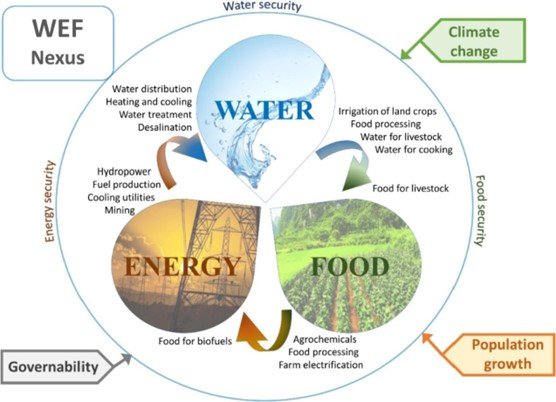
Fig. 1. Summary of the water-energy-food (WEF) Nexus. [6]
Legislative Framework – INDIA
Article 246 of the Constitution of India lays out the federal structure of India by defining the scope of the Union Parliament’s and the State Legislatures’ power to make laws.
‘Water’ is covered under Entry 17 of the State List:
17. Water, that is to say, water supplies, irrigation and canals, drainage and embankments, water storage and water power subject to the provisions of entry 56 of List I.
56. Regulation and development of inter-State rivers and river valleys to the extent to which such regulation and development under the control of the Union is declared by Parliament by law to be expedient in the public interest.
Water being a State subject, steps for augmentation, conservation and efficient management of water resources are primarily undertaken by the respective State Governments.
The Central Government provides technical and financial assistance through various schemes and programmes.
At present, the National Water Policy – 2012 is in effect.
The Government of India in partnership with States is implementing the Jal Jeevan Mission (JJM) – Har Ghar Jal.
The Government of India launched the Atal Mission for Rejuvenation & Urban Transformation (AMRUT) as a water-focused national urban mission in 2015.
Water Solutions
💧 Healthy aquatic ecosystems and improved water management can lower greenhouse gas emissions and provide protection against climate hazards. [7]
💧 Wetlands such as mangroves, seagrasses, marshes, and swamps are highly effective carbon sinks that absorb and store CO2. [8]
💧 Wetlands also serve as a buffer against extreme weather events. [9]
💧 Early warning systems for floods, droughts, and other water-related hazards provide a more than tenfold return on investment. [10]
💧 Water supply and sanitation systems that can withstand climate change could save the lives of more than 360,000 infants every year. [11]
💧 Climate-smart agriculture using drip irrigation and other means of using water more efficiently can help reduce demand for freshwater supplies. [12]
Views
‘Water’ as a resource and its availability and safe management cannot be viewed in isolation.
Plans and policies would need to be integrated and implemented accordingly.
It would not be correct to state that the foregoing is not understood or implemented by law and policymakers.
However, a breakdown for effecting ‘call to action’ must be clear:
💧 Sensitisation: awareness about the issues surrounding water at all levels.
💧 Transformational steps: Policy at the Central level and legislative efforts at the State Levels.
💧 Community-level actions and individual-level actions.
A comprehensive and coordinated approach, along with a sense of urgency would be helpful.
Suniti Kaur (Ms)
Co-Founder & Managing Partner at Alaya Legal