
| Date | Version | 7th June, 2023 | 1.0 |
| Keywords | Solar Energy, Sustainability, Solar Parks, Emissions |
| Legislation(s) and Policy(ies) |
|
| Jurisdiction | India |
Expert guidance from energy legal advisor and infrastructure legal advisor is advisable to handle projects in these areas as an integrated approach would be required which needs to flow down to transaction and documentation structuring.
Introduction
As per the report on World Energy Outlook 2021 of the International Energy Agency (IEA), the then-current share of India in the global primary energy consumption was 6.1% and is likely to increase to about 9.8% understated policies scenarios by 2050.
India’s dependence on coal, oil, and natural gas as a source of energy is projected to grow as a result of this increase in demand for power.
But not only will domestic coal production and oil imports fall short of meeting demand, they will also have an adverse impact on the environment and the economy.
One of the ways India can improve its energy security in the face of rising demand is by increasing the number of solar power units and its reliance on solar energy.
The Government has also announced its aim of achieving 500 GW installed capacity from the non-fossil fuel-based capacity (Hydro, Nuclear, Solar PV, Wind, Biomass, etc.) by 2030.
Towards achieving its aim, India has set its sight to further harness the power of the sun.
With its abundant sunlight resources, the country has embarked on a remarkable journey towards expanding solar power generation and shaping a brighter, greener future.
In recent years, India has made significant strides in adopting solar energy on a large scale.
The nation’s commitment to solar energy was underpinned by the launch of the ambitious Jawaharlal Nehru National Solar Mission in 2010.
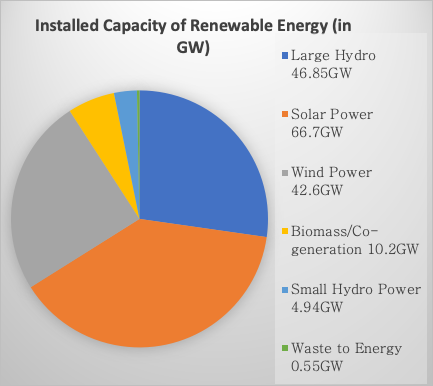
Source: National Investment Promotion and Facilitation Agency (India), February 2023
This article seeks to provide an overview with respect to the growth of solar power in India and identify the growth factors.
International Framework
UNFCCC and the Paris Agreement
The United Nations Framework Convention on Climate Change secretariat (UN Climate Change) is the United Nations entity tasked with supporting the global response to the threat of climate change.
The United Nations Framework Convention on Climate Change (UNFCCC) was signed in 1992 at the United Nations Conference on Environment and Development, also called the ‘Earth Summit’.
The UNFCCC is the parent treaty of the Paris Agreement.
The Paris Agreement (also known as the Conference of Parties 21 or COP 21) was adopted by 196 Parties at the UN Climate Change Conference in Paris, France, on 12 December 2015.
The Agreement includes commitments from all countries to reduce their emissions and work together to adapt to the impacts of climate change and calls on countries to strengthen their commitments over time.
Its overarching goal is to hold “the increase in the global average temperature to well below 2°C above pre-industrial levels” and pursue efforts “to limit the temperature increase to 1.5°C above pre-industrial levels.”
The Agreement provides a framework for open monitoring and reporting of the climate goals of the participating countries while giving wealthier nations a method to support developing countries in mitigating and adapting climate change.
Nationally Determined Contributions
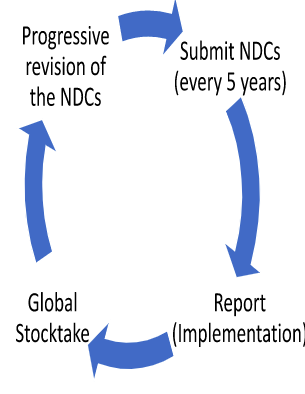
According to the Paris Agreement, countries must take progressively ambitious climate action over a five-year period.
Every country is required to submit an updated Nationally Determined Contribution (NDC), also known as a national climate action plan, every five years.
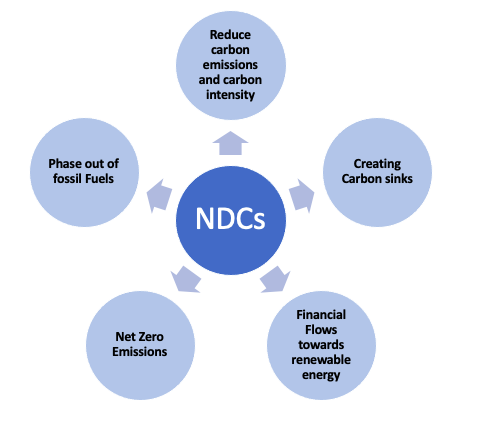
Countries outline the steps they will take in their NDCs to reduce their greenhouse gas emissions in order to achieve the purpose of the Paris Agreement.
Additionally, nations outline in their NDCs the steps they will take to strengthen their capacity for adaptation to the effects of global warming.
The first “global stocktake” will evaluate the Paris Agreement goals in December 2023.
This procedure is intended to provide nations with more motivation to adopt aggressive climate change measures to keep global warming below 1.5 degrees Celsius.
India NDCs
India submitted its Intended Nationally Determined Contribution (NDC) to the United Nations Framework Convention on Climate Change (UNFCCC) on 2nd October 2015.
In the 26th session of the Conference of the Parties to the UNFCCC, the Panchamrit action plan was presented by the Government of India towards its commitment to climate action.
This was then revised in August 2022, and the main submissions include:
- To reduce the Emissions Intensity of its GDP by 45% by 2030, from the 2005 level.
- To achieve about 50% cumulative electric power installed capacity from non-fossil fuel-based energy resources by 2030, with the help of the transfer of technology and low-cost international finance, including from the Green Climate Fund.
- To create an additional carbon sink of 2.5 to 3 billion tonnes of CO2 equivalent through additional forest and tree cover by 2030.
International Solar Alliance
The International Solar Alliance (ISA) was launched as a joint effort by India and France at the United Nations Climate Change Conference in 2015 in Paris (COP 21).
It is a platform that works to create and implement solar-powered energy solutions to assist member states in pursuing low-carbon growth trajectories.
The ISA is focused particularly on Least Developed Countries and the Small Island Developing States.
The ISA is driven by its “Towards 1000” strategy, which seeks to mobilize USD 1,000 billion of investments in solar energy solutions by 2030 while delivering electricity access to 1,000 million people using clean energy solutions and resulting in the installation of 1,000 GW of solar energy capacity.
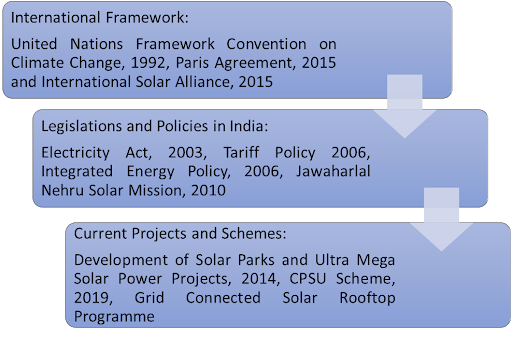
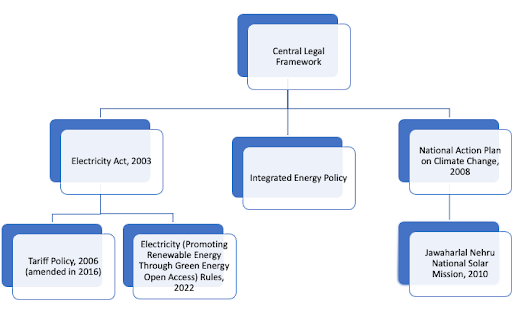
Framework in India
By the late 2000s, there was growing pressure on the Indian Government to take action to mitigate climate change at several international forums.
Renewable energy sources did not contribute much to the whole energy industry, which was run mostly on coal as a fuel source.
The solar sector attracted increasing attention from policy circles due to its potential to advance the industry, create jobs, and downward trends in harnessing solar electricity.
A mission-based drive for the solar sector made sense for policymakers when they combined these concerns and interests with India’s ongoing energy shortfall and dependence on imports.
The energy policy of India is primarily shaped to ensure energy security and self-sufficiency.
Sources
[1] M. Goel, Solar rooftop in India: policies, challenges and outlook, Green Energy & Environment 1 (2) (2016) 129–137.
[2] N. Saxena, Solar energy as renewable energy systems: perspective and challenges in the Indian context, Int. J. Eng. Technol. Sci. Res. 5 (1) (2018)
[3] Tariff Policy, Ministry of Power, Government of India, (2006) https://powermin.nic.in/sites/default/files/webform/notices/Tariff_Policy-Resolution_Dated_28012016.pdf
[4] Planning Commission, Government of India, https://planningcommission.nic.in/reports/genrep/intengpol.pdf
[5] National Action Plan on Climate Change, Government of India, Prime Minister’s Council on Climate Change. http://www.moef.nic.in/downloads/home/Pg01-52.pdf
[6] Jawaharlal Nehru National Solar Mission Policy Document, Ministry of New & Renewable Energy, 2012, https://mnre.gov.in/file-manager/UserFiles/draftjnnsmpd-2.pdf
[7] S.K. Suman, J. Ahamad, Solar energy potential and future energy of India: An Overview, Int. J. Eng. Sci. (2018) 17575.
[8] Ministry of New and Renewable Energy, Government of India https://mnre.gov.in/scheme-documents
[9] United Nations Framework Convention on Climate Change https://unfccc.int/news/international-solar-alliance-enters-into-force
[10] Ministry of New and Renewable Energy, https://mnre.gov.in/solar/schemes/
[11] India Solar Resource Map: Solar Energy Centre, Ministry of New and Renewable Energy, Government of India. Available: http://mnre.gov.in/sec/solarassmnt.htm
[12] Raghuwanshi S, Arya R, Renewable energy potential in India and future agenda of research, International Journal of Sustainable Engineering, 2019.
[13] Rehman S, Hussain Z Renewable energy governance in India: challenges and prospects for achieving the 2022 energy goals, Journal of Resources, Energy, and Development. 14(1):13–22., (2019)
[14] Hemani Paliwal, Green Energy Sources in India: Current Status and Future Potential, International Journal of Engineering, 2021.
[15] https://www.investindia.gov.in/sector/renewable-energy#:~:text=The%20following%20is%20the%20installed,%2FCo%2Dgeneration%3A%2010.2%20GW
[16] UNFCCC, https://unfccc.int/sites/default/files/NDC/2022-08/India%20Updated%20First%20Nationally%20Determined%20Contrib.pdf
[17] Press Information Bureau (PIB), MNRE has asked each State/UT to develop at least one Solar City, Ministry of New and Renewable Energy, March 2023. https://pib.gov.in/PressReleasePage.aspx?PRID=1907699

Suniti Kaur (Ms) and Samridhi Gandhi (Ms)

Co-Founder & Managing Partner at Alaya Legal