
| Reference Date | Publication Date | Version | July 11, 2023 | August 07, 2023 | 1.0 |
| Keywords | ‘Climate Change’, ‘GHG Emissions’, ‘Carbon Markets’, ‘Carbon Credits’ |
| List of Legislation Referred |
|
| Jurisdiction | India |
Introduction
Climate change is one of the biggest problems humanity faces in today’s day and age.
This issue’s urgency and importance have led nations to tackle it.
The heavy reliance and over-exploitation of fossil fuels have led to irreversible changes across the globe, and it is the need of the hour to, at the very least, stop further exploitation of these resources.
Given that entities across the globe are so heavily dependent on fossil fuels, a blanket ban on greenhouse gas emissions by these entities shall be detrimental to the economic growth and progress of nations.
Additionally, the progress made in the Renewable Energy sector is far from replacing the existing fossil fuel structures.
Thus, the concept of carbon markets evolved, incentivising entities to switch to greener energy sources by selling the credits obtained to entities looking to offset their excess emissions.
This Article shall briefly discuss the evolution of carbon markets under the Kyoto Protocol and Paris Agreement before discussing the framework laid down in India to achieve the Nationally Determined Contributions (‘NDCs’) committed by India under the Paris Agreement.
The Article shall then look at the obstacles in governing and regulating the Indian carbon market and discuss the potential solutions that can be employed in the near future to address this.
The Emergence Of Carbon Markets
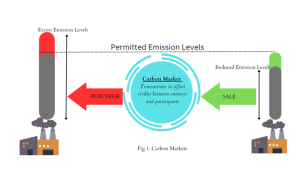
In the simplest of terms, carbon markets are systems or platforms where carbon credits are bought and sold.
Companies or individuals can use such carbon credits to compensate for greenhouse gas emissions by purchasing them from entities that have contributed towards the removal or reduction of greenhouse gas emissions.
Upon using a carbon credit to reduce or avoid emissions, it shall be no longer tradeable.
Therefore, a price is being put on greenhouse gas emissions by making it a tradable commodity.
The rationale for such carbon markets is simple; if polluters pay for their carbon emissions, it shall provide them with a good enough reason to reduce emissions.
Under the Kyoto Protocol, the Clean Development Mechanism (‘CDM’) sets emission reduction targets for countries while incentivising developing countries to develop emission-reduction projects to earn certified emission reduction credits equalling one tonne of CO2. [1]
These certified emission reduction credits have also provided flexibility to industrialised countries to meet their emission reduction targets through trade.
Over the years, two kinds of carbon markets have evolved – compulsory and voluntary.
Compulsory markets are constituted according to legislation(s) and regulated as specified.
Voluntary carbon markets are private initiatives not necessarily regulated by a specific legal regime.
Typically, third-party agents verify the credits obtained through voluntary carbon markets.
More recently, Article 6 of the Paris Agreement has enabled countries to cooperate voluntarily to achieve the emission reduction targets they set out in their NDCs. [2]
Under this provision, a country can transfer the credits earned by reducing GHG emissions to help other countries meet their targets.
While governments may transfer such emission reductions through authorisation, only one country may count them towards its NDC to avoid double counting and overestimating global emission reductions.
As a party to the Paris Agreement, India has also made legislative efforts to achieve its NDC.
Therefore, it is essential to understand the legislative foundation and framework for the carbon market in India.
Legal Framework In India
The Energy Conservation Act, 2001
The Energy Conservation Act aims to promote energy efficiency and conservation and provides a framework for regulating energy consumption.
The Bureau of Energy Efficiency has been constituted under the Energy Conservation Act to recommend standards and regulations for energy consumption.
The Central Government, under Section 14A of the Energy Conservation Act, has the power to issue energy savings certificates to designated consumers whose energy consumption is less than the prescribed norms and standards.
The designated consumers can buy energy-saving certificates to compensate for exceeding these consumption norms and standards.
During the COP-26 summit in 2021, specific commitments were made by India, including commitments such as reducing carbon emissions by one billion tonnes by 2030. [3]
As a step towards fulfilling India’s NDCs, in December 2022, The Energy Conservation (Amendment) Act, 2022 (‘Amendment Act’) was passed by the Parliament.
The Amendment Act empowers the Central Government to establish carbon credit trading markets in India.
The Amendment Act also amends the Energy Conservation Act to facilitate achieving the COP-26 goals by introducing concepts such as carbon credit trading and mandatory use of non-fossil sources.
The Amendment Act empowers the Central Government to specify a ‘carbon credit trading scheme’. [4]
Under the exercise of such powers, the Central Government has specified the Carbon Credit Trading Scheme, 2023.
The Amendment Act replaces the ‘Energy Conservation Code’ with the ‘Energy Conservation and Sustainable Building Code’.
This Code provides norms and standards for energy efficiency and its conservation, the use of renewable energy and other green building requirements.
The Electricity Act, 2003
The Electricity Act provides a comprehensive framework for developing and generating power and the preparation of a National Electricity Policy and Plan for developing a power system.
The Central Electricity Regulatory Commission (‘CERC’), constituted under the Electricity Act, regulates the Electricity market and undertakes tariff determination.
The Electricity Act also mandates the State Electricity Regulatory Commissions to specify terms and conditions to determine tariffs.
Concerning renewable energy, the terms and conditions set by these State Electricity Commissions have to be guided by:
- The factors which would encourage competition, efficiency, economical use of the resources, good performance and optimum investments.
- The promotion of co-generation and generation of electricity from renewable sources of energy.
- The National Electricity Policy and tariff policy. [5]
The CERC regulates Renewable Energy Certificates (‘RECs’) under the Electricity Act.
The RECs aim to promote renewable energy sources and develop an electricity market.
The RECs are also used by bulk purchasers such as discoms, open access consumers and other entities to fulfil their Renewable Purchase Obligation (‘RPO’).
A carbon credit certificate obtained under the carbon credit trading scheme shall be issued to obligated entities who comply with greenhouse gas emission norms.
Clarity would be required to ascertain the interplay among various certificates and avoid double counting.
The Ministerial Dilemma
The Government of India (Allocation of Business) Rules, 1961, framed under Article 77(3) of the Constitution of India, among other matters, sets forth the role and responsibility of the Ministry of Power.
Under the said Rules, the Ministry of Power is responsible for:
- General policy in the power sector and issues related to energy policy and coordination.
- Energy conservation and energy efficiency pertaining to the power sector.
The Ministry of Environment, Forest and Climate Change regulates:
- Climate change and related matters.
- Environmental norms.
- Forestry.
In foreign jurisdictions such as the US, Switzerland and the UK, the Environment Regulator or Ministry is responsible for schemes on carbon credits and carbon markets.
The Ministry of Environment, Forest and Climate Change has introduced the draft Green Credit Programme, 2023.
The relationship between carbon credits and green credits may cause the problem of duplicity, defeating the purpose of both schemes.
Carbon Credit Scheme: Features
The Central Government notified the Carbon Credit Trading Scheme, 2023 under Section 14(w) of the Energy Conservation Act.
The Carbon Credit Scheme defines a ‘power exchange’ as an electronic trading platform under the Central Electricity Regulatory Commission (Power Market) Regulations, 2021.
The Carbon Credit Scheme constitutes a National Steering Committee which includes members from various ministries. [6]
The functions of the National Steering Committee involve recommending rules, regulations and procedures for the trading of carbon certificates.
The Central Electricity Regulatory Commission (‘CERC’) shall act as the regulator for the Indian Carbon Markets. [7]
The Bureau of Energy Efficiency shall act as the administrator of the Indian Carbon Markets. [8]
There shall be accredited carbon verification agencies for verification activities under the Carbon Credit Scheme. [9]
The Grid Controller of India Limited shall discharge the role of the registry for the Indian Carbon market. [10]
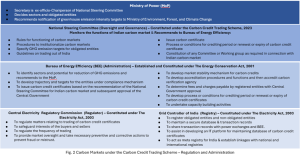
The Carbon Credit Scheme applies to registered entities as defined under the Energy Conservation Act.
The Carbon Credit Scheme classifies these registered entities into obligated and non-obligated entities. [11]
The Bureau of Energy Efficiency recommends to the Ministry of Power the sectors and obligated entities that shall come under the compliance mechanism.
Detailed procedures and functions under the Indian carbon market are yet to be laid down.
Governance
Governance in the context of carbon markets means incorporating mechanisms and processes for issuing, verifying and trading carbon credits.
Good governance of carbon markets is essential for achieving the objective of reducing greenhouse gas emissions and attaining the goals of sustainable development.
For effective governance, the carbon markets should be inclusive and transparent.
They should promote diversity in participation while also having flexible and scalable processes.
While the transition to greener energy has its benefits, ‘greenwashing’ can cause significant harm to this transition.
‘Greenwashing’ occurs when the true impact of the actions of an entity is not reflected transparently in the contributions they claim to have made. [12]
The Bureau of Energy Efficiency needs to ensure that the appointment of carbon verification agencies considers the authenticity of its carbon certificate.
Governance of such carbon markets shall be inclusive, multidimensional and flexible at every level of engagement.
The law shall incorporate provisions promoting equitable participation, sanctions for punishing malicious actors and safeguarding whistle-blowers.
To ensure equitable decision-making and benefit distribution, vulnerable populations and women shall be empowered to participate in carbon market governance. [13]
Viewpoint
At present, the greatest existential threat that humanity faces is climate change.
There has to be a transition from fossil fuels to non-fossil fuels in a comprehensive manner to ensure that countries meet the goals and commitments set by them.
The main issues that the carbon markets in India shall address are:
- Reducing emissions at the earliest.
- Protecting and developing carbon sinks for removing carbon dioxide from the atmosphere.
The Carbon Credit Scheme is the beginning of establishing the Indian carbon market.
The problem of greenwashing may be a challenge to the transition to greener energy and reduced emissions.
The consequences of greenwashing can be far-reaching.
It might lead to confusion among consumers and make them sceptical about whether there is an actual contribution to environmental efforts.
Given that the Indian carbon market is still nascent, the foundations for such a market should be based on transparency.
The accreditation agencies shall ensure the credibility and accuracy of the certificates obtained under the Carbon Credit Scheme.
These steps shall help achieve the true objective of the Carbon Credit Scheme rather than merely creating an industry that permits emissions in exchange for money.
The manner in which we implement and plan these potential solutions shall determine the future of our planet.
Sources
[1] What are carbon markets, and why are they important? UNDP Global Climate Promise, https://climatepromise.undp.org/news-and-stories/what-are-carbon-markets-and-why-are-they-important
[2] Id.
[3] India’s Stand at COP-26, https://pib.gov.in/PressReleasePage.aspx?PRID=1795071
[4] Section 2(db), The Energy Conservation Act, 2001.
[5] Section 61, The Electricity Act, 2003.
[6] Section 3, Carbon Credit Trading Scheme, 2023.
[7] Section 7, Carbon Credit Trading Scheme, 2023.
[8] Section 5, Carbon Credit Trading Scheme, 2023.
[9] Section 9, Carbon Credit Trading Scheme, 2023.
[10] Section 6, Carbon Credit Trading Scheme, 2023.
[11] Section 11, Carbon Credit Trading Scheme, 2023.
[12] Jennifer L, Inside Carbon Markets: Problems, Causes, and Potential Solutions, https://carboncredits.com/inside-carbon-markets-problems-causes-and-potential-solutions/
[13] Recommendations for the Digital Voluntary and Regulated Carbon Markets, World Economic Forum, March 2023.

Suniti Kaur (Ms) and Ashwini Panwar (Mr)

Co-Founder & Managing Partner at Alaya Legal