

| Reference Date | Version | August 13, 2025 | 1.0 |
| Keywords | Carbon Credit Trading Scheme (CCTS), Compliance Mechanism, Offset Mechanism, Carbon Market India, Bureau of Energy Efficiency (BEE), Nationally Determined Contributions (NDCs) |
| Legislation(s)/Policies |
(i) The Constitution of India (ii) Energy Conservation Act, 2001 (as amended in 2022) (iii) Carbon Credit Trading Scheme, 2023 (iv) Paris Agreement, 2015 |
| Jurisdiction | India |
The Carbon Credit Trading Scheme is a significant step in India’s evolving climate governance framework. The Carbon Credit Trading Scheme seeks to establish the Indian Carbon Market by pricing greenhouse gas emissions and enabling the trading of Carbon Credit Certificates.
As India transitions toward a low-carbon economy, the legal and regulatory complexities surrounding such carbon markets demand a multidisciplinary approach. Aspects related to the emissions trading system, the trading of carbon credits, and compliance with the reduction of greenhouse gas emissions intensity targets require guidance from legal experts.
A. Introduction
The Carbon Credit Trading Scheme (CCTS) has been introduced as part of the evolving international climate framework established under the Paris Agreement and the climate targets outlined in its Nationally Determined Contributions (NDCs). The Energy Conservation Act, 2001, as amended in 2022, provides a mechanism for developing the Indian Carbon Market (ICM) by implementing the CCTS.
This article examines the existing landscape governing CCTS in India.
B. India’s Global Commitments
Globally, countries have sought to come together to take effective action against Climate Change. The Paris Agreement is an international treaty that serves as an instrument for implementing this drive to take action against climate change.
The Paris Agreement was adopted by Parties at the 21st Conference of the Parties (COP21) to the United Nations Framework Convention on Climate Change (UNFCCC) on December 12, 2015. It aims to foster and strengthen a global response to the threat of climate change with a focus on sustainable development and efforts to eradicate poverty, while also enhancing the implementation of the UNFCCC.
- Under Article 4 (2) of the Paris Agreement, member states are obligated to maintain NDCs.
- Article 5 encourages Parties to take actions to conserve and enhance sinks and reservoirs of GHG.
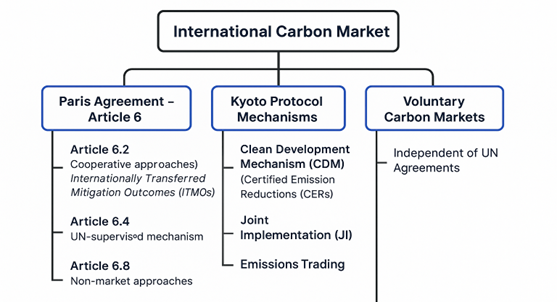
- Article 6 (4) of the Paris Agreement lays down the mechanism to contribute to the mitigation of GHG emissions and support sustainable development. It recognises that member states may involve the use of internationally transferred mitigation outcomes to achieve NDCs under the Agreement.
India became a signatory to the Paris Agreement on 22nd April 2016 and ratified it on 2nd October 2016. In accordance with Article 4 of the Paris Agreement, India submitted its intended NDCs to UNFCCC on 2nd October, 2015 and updated the NDCs in August 2022.
These updated NDCs commit to the following:
- Reduce the emissions intensity of its GDP by 45% from 2005 levels by 2030,
- Achieve 50% cumulative electric power installed capacity from non-fossil fuel-based energy sources by 2030,
- Create an additional carbon sink of 2.5 to 3 billion tonnes of CO₂ equivalent through forest and tree cover by 2030.
These targets underscore India’s intent to pursue climate action in a manner consistent with its developmental needs and constitutional mandate for environmental protection, as outlined in Article 48A of the Constitution of India.
C. Carbon Markets
Carbon markets may operate at the domestic or international level. Article 6 of the Paris Agreement enables countries to achieve their NDCs through voluntary cooperative approaches.
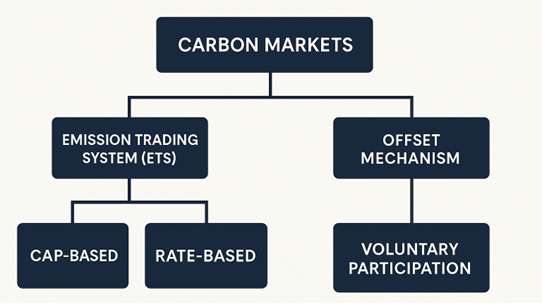
A domestic carbon market framework can be structured through a Compliance Mechanism and/or an Offset Mechanism for carbon pricing.
The international carbon market enables countries and companies to trade GHG emission reductions across borders.
D. Carbon Market in India – India’s Carbon Credit Trading Scheme
The CCTS in India is a mechanism designed to reduce GHG emissions through carbon pricing.
- The compliance mechanism: Applicable to obligated entities and addresses the reduction of GHG emissions from energy-intensive and industrial sectors.
- The Offset mechanism: Applicable on non-obligated entities to incentivise voluntary actions and participation in the reduction of GHG emissions.
Obligated and non-obligated entities must register to participate in the ICM.
E. Key Regulatory Bodies
- The National Steering Committee holds primary governance by setting GHG emission targets for obligated entities.
- The Bureau of Energy Efficiency (BEE) shall act as the Administrator of the Indian Carbon market.
- The Grid Controller of India Limited will serve as the Registry for the Indian carbon market.
- The Central Electricity Regulatory Commission (CERC) regulates trading activities within the Indian Carbon Market.
F. Regulatory and Institutional Framework Enabling CCTS
| S.No | Title | Description |
| 1. | Accreditation Procedure and Eligibility Criteria for Accredited Carbon Verification Agency | This provides the minimum eligibility requirements and procedures for accreditation. |
| 2. | Approved Sectors in Compliance Mechanism |
Nine approved sectors are gradually transitioning under CCTS:
|
G. Conclusion
The ICM is on the horizon, but not yet operational. To ensure the timely and effective operationalisation of ICM, certain critical steps must be prioritised.
India must take prompt action to ensure it remains competitive in this emerging carbon pricing landscape.
Additionally, while carbon credits and carbon credit trading are important market-based mechanisms for incentivising emission reductions, they are not a substitute for actual emission elimination at source.
Founded in 2003 by Divjyot Singh and Suniti Kaur, Alaya Legal takes pride in its boutique practice, encompassing Litigation & Arbitration, Corporate and Commercial, Energy & Sustainability and Information Technology (IT) and Artificial Intelligence (AI).
If you are interested in related topics such as carbon markets, emissions trading, or similar energy law aspects, reach out to our legal firm in Gurgaon .